Show me the English
Reviewing AI-written code is a bounded task — if the source exists. Naming the role that writes the source.
Every review of AI-written code I have watched go wrong went wrong the same way. The reviewer opened the diff, read the code, and tried to work out what it was supposed to do. There was nothing to check it against. So they interrogated the model, or the person, and got back a mood: I wanted it to handle the edge cases. I was going for something clean. That is not a specification. That is a vibe, and a vibe cannot be reviewed.
Here is the thing I want to put in the record, from a construction company in Rhode Island that runs seven AI agents on a house ledger: the review problem is upstream of the review. It is solved or not solved by whether the English exists.
The role has a name
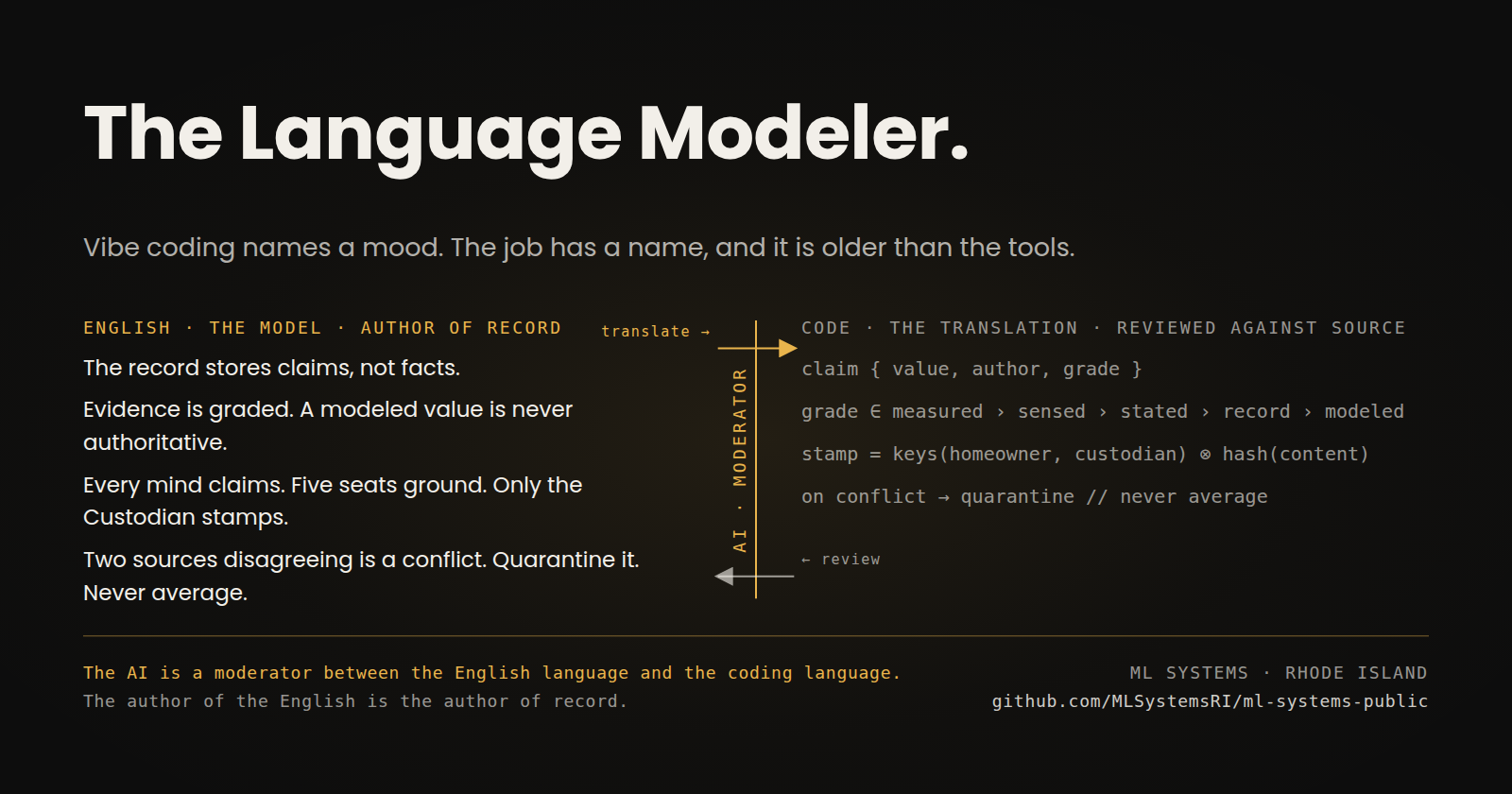
At ML Systems we do not say vibe coding. The role is Language Modeler. A Language Modeler models the system in language — what it is, what it is made of, what it is allowed to do, who may write to it, what counts as true inside it — precisely enough that the model can be carried into code without losing anything that matters. The AI is a moderator between the English language and the coding language. It carries the model across. It owns neither side.
That framing does something useful to review. If the English exists and is precise, reviewing the code is a check on translation. Did the code do what the sentence said? That is bounded. You can finish it. If the English does not exist, you are reverse-engineering intent from output, which is unbounded, and no amount of reading the code will tell you what it was supposed to do.
What the English looks like
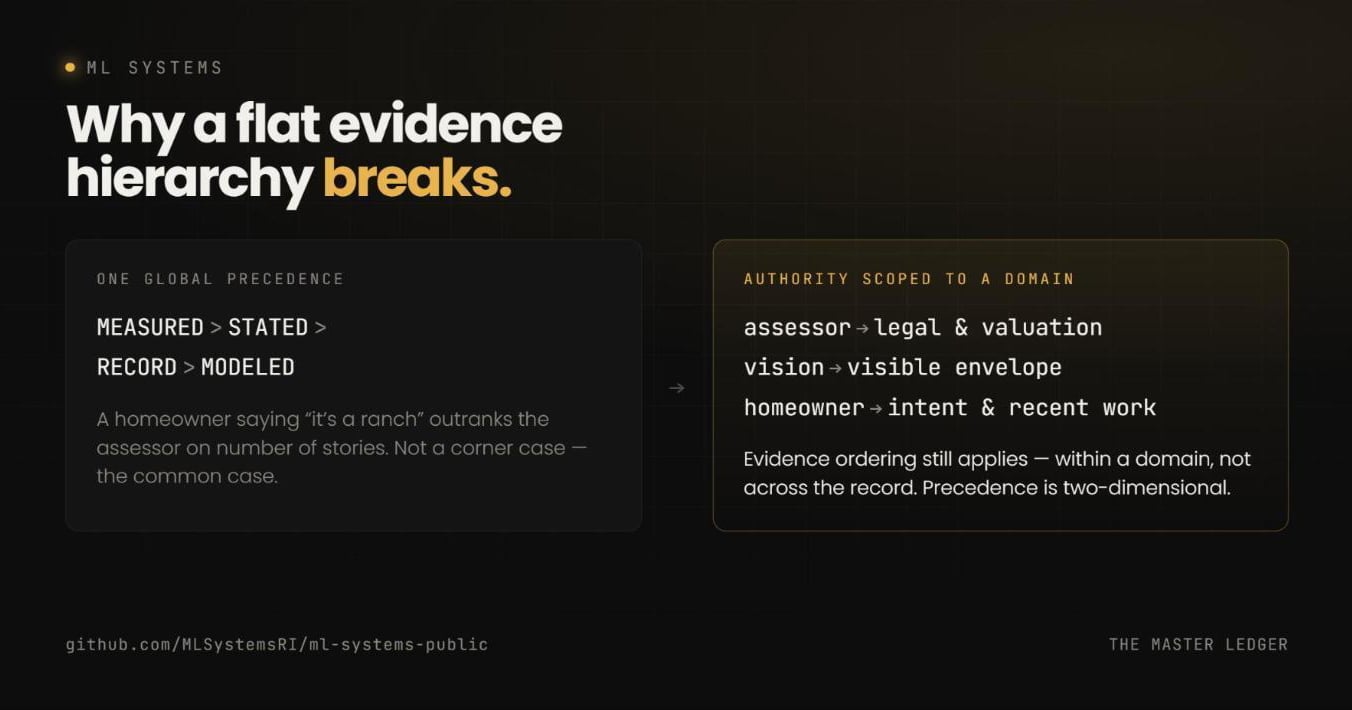
The Master Ledger — the house record my agents write to — is described in English before it is described in anything else. The model says: the record stores claims, not facts, and every value carries who made it and an evidence grade. Evidence sits on a ladder, measured › sensed › stated › record › modeled, and a modeled value is never authoritative. A model agreeing with the value it was derived from is concurrence, not a vote. Every mind claims, five seats ground, only the Custodian stamps. A stamp is two keys bound to a fingerprint of the content, so both lapse the moment the content changes. Two credible sources disagreeing is a conflict, quarantined and never averaged.
None of that is code. All of it became code. When the code did something the English did not say, the English was the thing I went back to, and the fix was a sentence. That is what a Language Modeler's review looks like: translation against source, then source against the world.
Why the accountability question disappears
A moderator between two languages is never the author of record. If the English was wrong, the Language Modeler owns it. If the translation was wrong, review catches it, or the Modeler owns that too. Nobody gets to say the AI did it, and nobody needs to. The people defending vibe coding already do this job — decomposing, orchestrating, validating — and have been calling it by a word that undersells it. The people attacking it are describing review of a translation, which is necessary and bounded and much easier when the source exists.
Labels
The software is MEASURED: a shipped app, a working ledger, an ontology seven agents and one human speak. No ML Systems deconstruction has been performed yet; the 80–90% recovery target is MODELED. The term Language Modeler is a position, not a standard, and it is in the record so it can be argued with.
The full piece, including why the first hire at ML Systems is a carpenter and a Language Modeler in one person: The Language Modeler.